Choosing the right wheelchair ramp can make steps, thresholds, and doorways easier to navigate while improving everyday accessibility at home. The best option depends on rise height, available space, chair type, and how often the ramp must be moved.
This roundup compares 10 portable, threshold, telescoping, and handrail-equipped models so you can narrow your choices by size, load capacity, stability, and installation needs.
Best 10 Wheelchair Ramps Picks for 2026
Best Seamless Aluminum Ramp
6-Foot Non-Slip Aluminum Wheelchair Ramp

- Supports up to 800 pounds
- Designed for 6- to 18-inch steps
- Folds for carrying and storage
Best For: Home steps, doorways, garages, and loading tasks
Best Threshold Ramp
VEVOR 3-Inch Rubber Doorway Ramp

- Fits 3-inch rises
- No tools or assembly required
- Grooved, beveled rubber design
Best For: Doorways, curbs, garages, and low transitions
Best Telescoping Ramp
7-Foot Portable Aluminum Wheelchair Ramp
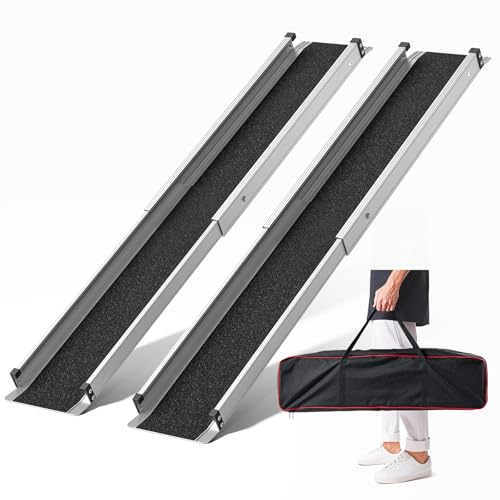
- Adjusts from 48 to 84 inches
- Includes a storage bag
- Rated for 600 pounds
Best For: Travel and home use with manual wheelchairs
Best Handrail Ramp
Folding Carbon Steel Ramp with Handrails

- Dual handrails add stability
- Supports up to 770 pounds
- Designed for 3- to 10-inch rises
Best For: Porches and low home steps needing extra support
Best Portable Pick

- 800-pound aluminum capacity
- Folds with a carrying handle
- Non-slip surface and reflective safety features
Best For: Home steps and portable wheelchair access
Best Heavy-Duty Option
CAMMOO 5FT Ramp with Handrails

- 1,200-pound maximum capacity
- 34-inch handrails for added support
- 36-inch width and triple anti-slip design
Best For: Home steps requiring handrails and high capacity
Best Compact Value

- Lightweight 23.8-pound folding design
- 800-pound aluminum capacity
- Double non-skid surface and safety reflectors
Best For: Lower home steps and portable everyday access
Best Heavy-Duty Portable Pick
12-Foot Aluminum Wheelchair Ramp

- 600-pound load capacity for substantial equipment
- Folds into two pieces with carrying handles
- Adjustable legs and anti-slip safety features
Best For: Long approaches, vehicles, and heavier mobility devices
Best Compact Threshold Pick

- Lightweight folding design with carrying handle
- 800-pound capacity for low thresholds
- Non-slip surface and guide rails for added control
Best For: Home steps and thresholds from 2 to 6 inches high
Best Handrail Model
CAMMOO 10-Foot Wheelchair Ramp

- 1,200-pound capacity and 36-inch width
- 34-inch handrails with adjustable support legs
- Triple anti-slip design for added stability
Best For: Home entry steps where hand support and capacity matter
Best Seamless Aluminum Ramp – 6-Foot Non-Slip Aluminum Wheelchair Ramp
This 6-foot aluminum option is one of the more versatile wheelchair ramps for home steps, doorways, garages, and vehicle loading. It is designed for step heights from 6 to 18 inches and supports up to 800 pounds, but buyers should confirm the rise and available landing space before ordering.
Best For: Homeowners needing a foldable ramp for compatible steps, thresholds, carts, strollers, pets, or manual mobility equipment.
Pros:
- Seamless center hinge helps reduce tripping concerns and pet paw entrapment.
- Folded aluminum construction, upgraded carrying handle, and 35.5-pound weight support portability.
- Folded surface, added non-skid layer, side baffles, reflective stickers, and transition plates provide several safety-oriented features.
- 800-pound capacity and stainless steel hinges suit a range of household and loading tasks.
Cons:
- Its recommended 6- to 18-inch step-height range limits use on lower thresholds.
- At 72 inches long and 35.5 pounds, it may be cumbersome for some users to carry and position.
- Buyers must stay within the stated 800-pound maximum capacity.
Choose this model when a wide, folding aluminum ramp with multiple traction and edge-safety details is more useful than an ultra-compact threshold ramp. Careful measurement is essential because the product is intended for a defined step-height range.
Best Threshold Ramp – VEVOR 3-Inch Rubber Doorway Ramp
This VEVOR rubber threshold ramp is built for a smooth transition over a 3-inch doorway or curb rise. Its one-piece design requires no assembly, while beveled edges and a grooved surface make it a practical choice for indoor or outdoor access points.
Best For: Doorways, garages, gardens, barns, and other locations needing a low-rise wheelchair, scooter, cart, or vehicle transition.
Pros:
- 35.5-inch length and 17.7-inch width provide a broad approach for compatible equipment.
- Beveled edges allow access from multiple directions.
- Grooved rubber tread is designed for traction, and the material is rust- and scratch-resistant.
- One-piece construction needs no tools and has a stated 2,200-pound capacity in the product features.
Cons:
- The 3-inch height is intended for smaller rises rather than stairs or tall steps.
- At 29 pounds, it is less convenient to move frequently than lighter portable ramps.
- The supplied details contain conflicting load-capacity figures, so buyers should verify the current listing before relying on the maximum rating.
This is a strong fit when the main accessibility problem is a single low threshold. Its solid rubber construction prioritizes stability and high load support, but the ramp’s dimensions and capacity should be checked against the specific doorway and equipment.
Best Telescoping Ramp – 7-Foot Portable Aluminum Wheelchair Ramp
These telescoping wheelchair ramps extend from 48 to 84 inches, giving users adjustable length for home steps, vehicles, and travel. The two-piece aluminum set weighs about 20 pounds and includes a storage bag, though the product is specified for manual wheelchairs and is not compatible with power wheelchairs or scooters.
Best For: Manual wheelchair users and caregivers who need adjustable, portable access at home or while traveling.
Pros:
- Adjustable 48- to 84-inch length accommodates different setup locations.
- Two-piece design, lightweight carry format, and included bag simplify transport and storage.
- Tool-free extension with lock controls supports quick setup.
- Aluminum construction, triple anti-skid treatment, and a 600-pound capacity provide practical everyday utility.
Cons:
- It is not compatible with power wheelchairs or scooters according to the supplied product information.
- Users must verify the required ramp length before purchase and each setup.
- The listed 600-pound capacity may not suit heavier combined user-and-equipment loads.
This model makes the most sense for buyers who value adjustable length and travel storage over a permanently installed ramp. Confirm the needed incline and use only with compatible manual wheelchair setups.
Best Handrail Ramp – Folding Carbon Steel Ramp with Handrails
This folding carbon steel ramp combines dual handrails with a high-traction surface for users who want added gripping support on home steps or porches. It is designed for a 3- to 10-inch rise, supports up to 770 pounds, and requires assembly with the included labeled hardware and manual.
Best For: Seniors, caregivers, wheelchair and scooter users, and households needing handrail-supported access over compatible low steps.
Pros:
- Dual integrated handrails offer additional support for users and caregivers.
- 770-pound capacity is specified for power wheelchairs, scooters, and heavy medical equipment.
- High-traction coating is intended to maintain grip in wet or icy conditions.
- Folding, disassemblable construction and reflective strips support storage, transport, and visibility.
Cons:
- Assembly is required, although the supplied information describes a simplified setup process.
- Its 40-pound weight and handrails may make transport less convenient than compact threshold ramps.
- Use is limited to compatible rises between 3 and 10 inches.
Consider this ramp when hand support and a higher stated load capacity are priorities. It is more substantial than a basic portable threshold ramp, so measure the rise and landing area and plan for a secure installation.
Best Portable Pick – FACHNUO 6FT Wheelchair Ramp
For buyers comparing wheelchair ramps for home steps, the FACHNUO 6-foot model combines a broad aluminum surface, folding storage, and support-focused safety features. It is rated for up to 800 pounds and is recommended for step heights from 6 to 18 inches, so check the size guidance before ordering.
Best For: Home steps, doorways, and users who need a portable ramp for wheelchairs, scooters, walkers, or carts.
Pros:
- 800-pound capacity with a durable, corrosion-resistant aluminum construction.
- Folds to a more manageable size and includes a suitcase-style carrying handle.
- Non-slip pleated surface, side baffles, reflective strips, and extended guide rails support safer use.
- Measures 72 by 29 inches when unfolded, providing a wide travel surface.
Cons:
- At 35.2 pounds, it may be heavy for some users to carry.
- The recommended step-height range is limited to 6–18 inches.
- The manufacturer notes that long ramps may sink during use before rebounding.
The FACHNUO is a practical choice when portability and a wide, reinforced ramp surface matter. Its 6-foot length offers more gradual access than shorter options, but buyers should confirm the step height and plan for the ramp’s weight.
Best Heavy-Duty Option – CAMMOO 5FT Ramp with Handrails
Among wheelchair ramps with built-in support, the CAMMOO 5-foot model stands out for its 1,200-pound capacity and 34-inch handrails. Its 36-inch-wide ramp is designed for steps from 5 to 15 inches tall, but the stated slope guidance should be reviewed carefully before use.
Best For: Home entry steps, recovery support, and users seeking handrails and a high load rating.
Pros:
- Heavy-duty aluminum alloy construction supports up to 1,200 pounds.
- 34-inch handrails provide additional support while using the ramp.
- 36-inch ramp width accommodates wheelchairs, walkers, rollators, scooters, and carts.
- Textured ramp surface, transition-plate pad, and anti-slip handrail covers provide three anti-slip features.
Cons:
- At 51 pounds, it is considerably heavier than the other listed ramps.
- The 5-foot length may not provide a suitable slope for taller steps; the notes give a 1:12 guideline.
- Soft handrail grips may arrive with packaging creases that take 3–5 days to smooth.
The CAMMOO is the strongest fit for shoppers prioritizing handrails, width, and load capacity over easy carrying. Confirm the step height and required slope before installation, and use assistance as recommended.
Best Compact Value – Portable 4FT Wheelchair Ramp
This 4-foot option is one of the more compact wheelchair ramps for home use, folding for transport and storage while supporting up to 800 pounds. It is intended for steps measuring 4 to 12 inches high, making it best suited to lower entry steps and similar transitions.
Best For: Lower home steps, garage entries, doorways, and portable use with wheelchairs, scooters, walkers, carts, or strollers.
Pros:
- Folding aluminum design weighs 23.8 pounds and includes a comfortable carrying handle.
- 800-pound load capacity for a range of mobility and utility equipment.
- Double non-skid protection combines a folded surface design with a non-skid layer.
- Baffles, reflective warning stickers, stainless steel hinges, and transition plates add practical safety and durability features.
Cons:
- Its 4-foot length is limited to step heights from 4 to 12 inches.
- The manufacturer notes that the long ramp may sink during use before rebounding.
- At 29.2 inches wide, it may not suit every setup or mobility device.
Choose this model when easy carrying and storage are more important than reaching taller steps. Its lower weight and folding design are convenient, but measuring the step and available landing space is essential.
Best Heavy-Duty Portable Pick – 12-Foot Aluminum Wheelchair Ramp
For homes, vehicles, steps, and loading tasks that require extended reach, this 12-foot wheelchair ramp combines a 600-pound capacity with a foldable two-piece design. Its adjustable support legs and multiple visibility and traction features add stability for larger mobility devices.
Best For: Long entryways, vehicle loading, mobility scooters, and heavier wheelchairs or equipment.
Pros:
- 12-foot length and 600-pound load capacity.
- Folds into two pieces and includes carrying handles.
- Includes adjustable support legs, security pins, reflective strips, and an anti-slip surface.
- Designed to accommodate wheelchairs, power chairs, and mobility scooters.
Cons:
- At 93.3 pounds, it is relatively heavy to transport.
- Its extended length requires substantial storage space.
This is a strong choice when a long, supportive ramp matters more than minimal weight. Check the available approach space and follow the manufacturer’s guidance for selecting the appropriate ramp size.
Best Compact Threshold Pick – FACHNUO 2-Foot Portable Ramp
For small steps and doorway thresholds, this compact folding wheelchair ramp offers a portable solution without setup. The non-slip aluminum surface, guide rails, reflective strips, and carrying handle make it practical for temporary indoor or outdoor access.
Best For: Home thresholds and steps approximately 2 to 6 inches high, especially when portability and storage are priorities.
Pros:
- Lightweight 10.9-pound folding design with a built-in handle.
- Rated for up to 800 pounds.
- Textured non-slip surface, extended guide rails, baffles, and reflective strips.
- Corrosion-resistant stainless steel hinge supports indoor and outdoor use.
Cons:
- The manufacturer recommends limiting wheelchair step use to heights of 4 inches or less.
- Wheelbase must not exceed 27 inches.
- Its extension plate may interfere with some doors or sliding-door tracks.
This ramp is convenient for low thresholds, but careful measuring is essential. Confirm the step height, wheelchair wheelbase, door clearance, and extension-plate position before purchasing.
Best Handrail Model – CAMMOO 10-Foot Wheelchair Ramp
CAMMOO 10 FT Wheelchair Ramp with Handrails, 1200LBS Load Capacity, with Adjustable Legs
Check Price On AmazonWhen users need hand support in addition to a ramp surface, this 10-foot wheelchair ramp adds 34-inch handrails, adjustable legs, and a 1,200-pound capacity. Its 36-inch width and three-part anti-slip design suit home entry steps and several types of mobility equipment.
Best For: Home entrances and users who benefit from handrails, extra width, and heavy-duty support.
Pros:
- 1,200-pound maximum load capacity with a 36-inch ramp width.
- Includes 34-inch handrails and adjustable bottom support legs.
- Textured surface, non-slip transition pad, and anti-slip handrail covers.
- Compatible with wheelchairs, knee scooters, rollators, walkers, and utility carts.
Cons:
- At 114.9 pounds, it is not especially lightweight.
- The handrail version needs more vertical and lateral clearance than a basic ramp.
- Use requires assistance according to the product guidance.
This model emphasizes stability and user support rather than easy carrying. Verify the step height and available clearance, using the stated 1:12 guideline when planning a gentler approach.
How We Picked These Wheelchair Ramps
We selected models that cover common accessibility needs, from small doorway thresholds and low steps to longer exterior rises. The lineup includes folding or portable aluminum ramps, telescoping designs, heavy-duty steel options, and ramps with handrails or adjustable support legs.
Our comparison focuses on practical specifications: ramp length, stated weight capacity, surface traction, width, portability, support features, and suitability for different types of entryways. Always confirm the manufacturer’s measurements and safety instructions before use.
Quick Comparison
| Ramp type | Best suited for | Features to prioritize |
|---|---|---|
| 2–4 feet | Low steps and short rises | Light weight, nonslip surface, easy storage |
| 5–7 feet | Typical home steps and portable use | Stable construction, carrying handles or bag, adequate width |
| 10–12 feet | Higher rises and gentler slopes | Support legs, secure placement, sufficient landing space |
| Threshold ramps | Doorsills and small transitions | Exact threshold height, broad usable width, molded traction |
| Handrail ramps | Users who need walking support | Rail height, adjustable legs, platform stability |
Key Buying Factors for Wheelchair Ramps
Measure the Rise and Available Run
Measure the vertical height from the ground to the top surface, then check the manufacturer’s recommended slope. A longer ramp generally provides a gentler incline, but it also needs more ground space. Leave room at the top and bottom for safe positioning and maneuvering.
Check Capacity, Width, and Equipment Compatibility
Compare the stated load rating with the combined weight of the user and wheelchair, scooter, or other mobility device. Usable width matters as much as overall width, particularly for powered chairs and scooters. Verify door clearance, landing dimensions, and whether the ramp can accommodate the device’s wheelbase.
Prioritize Traction and Stability
Look for a textured or nonslip surface suitable for the conditions where the ramp will be used. Outdoor ramps should be positioned on stable, level ground and checked for movement before every use. Support legs, handrails, safety edges, and transition plates can improve confidence and stability, but they do not replace secure setup.
Balance Portability with Durability
Aluminum models are usually easier to carry and resist corrosion, while steel construction can offer substantial rigidity at the cost of extra weight. Folding, telescoping, and carry-bag designs are useful when the ramp must travel or be stored frequently.
Who Should Buy Which Wheelchair Ramps?
Choose a compact threshold or 2–4-foot ramp for a doorsill or one low step. A 5–7-foot portable model is a practical starting point for many residential entrances. If the rise is taller or a gentler incline is required, consider a 10–12-foot model with support legs and enough room for proper placement.
Users who need balance assistance should look for handrails, while caregivers who transport the ramp regularly may prefer a lighter aluminum or telescoping design. For any ramp, confirm the rise, load capacity, usable width, surface condition, and setup requirements before purchasing.