Choosing the right wheelchair ramp with handrails can make entrances safer and easier to navigate for wheelchair users, caregivers, and anyone using a mobility device. The best option depends on rise height, ramp length, available space, weight capacity, and how often the ramp will be moved.
We selected 10 ramps ranging from compact threshold models to long, heavy-duty designs with adjustable legs. Use the guide below to compare their most important features and find a practical fit for your home, vehicle, or commercial entrance.
Best 10 Wheelchair Ramp with Handrails Picks for 2026
Best Adjustable Steel Option

- Adjustable support feet for varied rises
- Dual handrails and reflective strips
- Folding carbon-steel construction
Best For: Adjustable home access over steps and thresholds
Best Long Aluminum Ramp
8-Foot Aluminum Ramp with Handrails
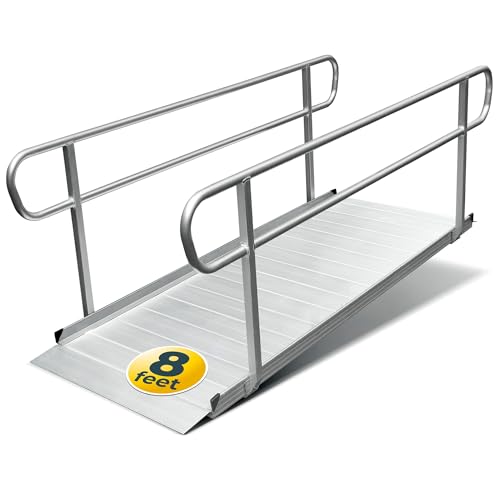
- 96.5-inch aluminum ramp length
- 37-inch usable ramp width
- Grooved surface and double handrails
Best For: Longer home entrances and patio access
Best Portable Short Ramp

- Folds for transport and relocation
- 900-pound stated load capacity
- Adjustable flap and rubber handrails
Best For: Temporary access over low steps and curbs
Best Heavy-Duty Aluminum Ramp

- 1,200-pound stated maximum capacity
- Adjustable legs and 36-inch width
- Three anti-slip safety features
Best For: High-capacity access over taller home steps
Heavy-Duty Choice
12FT Wheelchair Ramp with Handrails

- 1,300-pound stated load capacity
- Long aluminum ramp with non-slip surface
- Active tailplate and integrated handrails
Best For: Taller home steps and high-capacity access
Adjustable Support Pick
7FT Wheelchair Ramp with Handrails

- Adjustable legs improve support
- Triple anti-slip protection
- 1,200-pound capacity and 36-inch width
Best For: Home thresholds and moderate-height steps
Compact Entry Option

- Lightweight 30-pound aluminum design
- Double-sided handrails for support
- Extended transition plates at both ends
Best For: Short thresholds, doorways, and portable use
Best Compact Home Ramp
3-Foot CAMMOO Ramp with Handrails

- 1,200-pound aluminum capacity
- Three anti-slip features
- Fits 3- to 9-inch steps
Best For: Short home thresholds and entry steps
Best Long-Run Ramp
12-Foot Carbon Steel Ramp with Handrails

- 12- to 36-inch adjustable rise
- 850-pound carbon steel capacity
- Full-length handrails and traction deck
Best For: Porches, garages, and taller outdoor approaches
Best Adjustable Threshold Ramp
VEVOR Aluminum Ramp with Handrails

- Fits thresholds up to 6 inches
- 1,000-pound aluminum capacity
- Adjustable legs and dual handrails
Best For: Doorways, curbs, and modest threshold gaps
Best Adjustable Steel Option – RDCMKL 10–30-Inch Ramp
If you need a wheelchair ramp with handrails for changing home-step heights, this RDCMKL model offers adjustable support feet, a textured surface, and reflective strips. Its carbon-steel construction is designed for repeated access use around porches, garages, patios, and entryways.
Best For: Homeowners who want an adjustable, folding ramp for steps and thresholds, along with added guidance for seniors, wheelchair users, and caregivers.
Pros:
- Adjustable support feet and pre-drilled holes accommodate rises within the stated 8–30-inch range.
- Dual handrails, reflective strips, and a textured traction surface support steadier movement.
- Folding carbon-steel design supports wheelchairs, strollers, carts, walkers, and other mobility equipment.
Cons:
- Permanent installation for many heights requires securing the ramp with screws.
- The supplied details list both an 850-pound load capacity and a 1,000-pound construction claim, so buyers should verify the applicable rating.
This is a practical choice when adjustability and compact storage matter more than a long, fixed run. Measure the rise and confirm the installation points before ordering.
Best Long Aluminum Ramp – 8-Foot Aluminum Ramp with Handrails
This 8-foot wheelchair ramp with handrails provides a broad, weather-resistant access surface for home entrances, patios, and residences. Its grooved aluminum deck, double handrails, and included installation hardware make it suited to users seeking a longer, durable ramp.
Best For: Wheelchair and scooter users who need a wide, rust-resistant ramp for rises up to 16 inches when following the stated 1:12 ADA-recommended guidance.
Pros:
- High-strength aluminum is described as rust-proof and corrosion-resistant for indoor or outdoor use.
- Offers a 37-inch usable width, 36-inch handrails, and an 850-pound load capacity.
- Includes tools, instructions, rubber corner protectors, and pre-drilled holes for optional mounting.
Cons:
- At 96.5 inches long, it requires substantial storage and installation space.
- Its suitable rise depends on maintaining the recommended slope and the type of mobility device used.
The generous length and aluminum build make this a strong option for a more permanent access route. Check available space, landing areas, and the actual step height before installation.
Best Portable Short Ramp – 4-Foot Carbon-Steel Ramp
For a wheelchair ramp with handrails that is easier to relocate, this 4-foot carbon-steel model folds into a portable format and includes an adjustable ground flap. The diamond-pattern surface, grip tape, securing pins, and rubber handrails are aimed at improving control over modest rises.
Best For: Temporary or semi-permanent access over 4–12-inch rises, especially around doorways, garages, porches, curbs, and low steps.
Pros:
- Compact 43-inch length and folding design simplify transport and relocation.
- Supports up to 900 pounds and is made from corrosion- and rust-resistant carbon steel.
- Dual rubber handrails, an adjustable flap, traction surface, and anti-slip tape add practical stability features.
Cons:
- The 4-foot length is intended for relatively low rises and may not suit taller steps.
- At 57.7 pounds, it is portable but still substantial to carry.
This ramp balances mobility with heavy-duty construction and is particularly useful when access needs change between locations. Confirm that the rise falls within its recommended range and that the landing is clear.
Best Heavy-Duty Aluminum Ramp – CAMMOO 10-Foot Ramp
CAMMOO 10 FT Wheelchair Ramp with Handrails, 1200LBS Load Capacity, with Adjustable Legs
Check Price On AmazonThe CAMMOO 10-foot wheelchair ramp with handrails is built for higher-capacity access, with adjustable legs, a 36-inch ramp width, and a stated 1,200-pound maximum load. Its textured surface, transition plates, and covered handrails provide several features intended to support use at home and during recovery or loading tasks.
Best For: Users needing a long, high-capacity aluminum ramp for 10–30-inch steps, provided the setup follows the appropriate slope and is used with assistance.
Pros:
- High-strength aluminum construction has a stated 1,200-pound maximum capacity.
- Adjustable bottom legs and rear transition plate help accommodate different setups.
- Triple anti-slip design combines a textured deck, transition-plate pad, and anti-slip handrail covers.
Cons:
- At about 131 inches long and 114.9 pounds, it needs considerable space and effort to position.
- The product notes advise use with assistance, so it may not be appropriate for independent use in every situation.
- Soft handrail grips may arrive with packaging creases that take 3–5 days to smooth.
This is the most capacity-focused option in the group, but its size and weight favor a planned installation rather than frequent movement. Measure the step, landing, and storage area carefully before buying.
Heavy-Duty Choice – 12FT Wheelchair Ramp with Handrails
The FACHNUO 12FT wheelchair ramp with handrails is designed for taller steps and demanding home-entry applications. Its aluminum build, non-slip surface, active tailplate, and 1,300-pound stated capacity provide a substantial access solution, though the supported step height should not exceed 36 inches.
Best For: Home steps, doorways, and users needing a long, high-capacity ramp for wheelchairs, scooters, walkers, or electric chairs.
Pros:
- Long 144-inch ramp length supports taller step transitions.
- Aluminum construction resists rust and corrosion for outdoor use.
- Integrated handrails and an active tailplate improve stability and transitions.
- Textured surface is designed for traction in varied weather.
Cons:
- At 132 pounds, it is less convenient to move than lighter portable ramps.
- The step height should not exceed 36 inches.
- Its large footprint may require significant storage space.
Choose this model when capacity and reach matter more than portability. The long format is useful for taller entries, while the handrails and adjustable transition plate add practical safety features.
Adjustable Support Pick – 7FT Wheelchair Ramp with Handrails
CAMMOO 7 FT Wheelchair Ramp with Handrails, 1200LBS Load Capacity, with Adjustable Legs
Check Price On AmazonThe CAMMOO 7FT wheelchair ramp with handrails balances a moderate length with adjustable support legs and several anti-slip features. Its 36-inch width and 1,200-pound capacity suit home thresholds, steps, and other temporary or semi-permanent access needs.
Best For: Home entrances, recovery periods, and users who want adjustable legs and handrails for added stability.
Pros:
- Adjustable bottom legs provide added support and stability.
- Triple anti-slip design combines a textured deck, transition-plate pad, and covered handrails.
- 36-inch width accommodates wheelchairs and other mobility aids.
- Supports up to 1,200 pounds and fits steps listed at 7 to 21 inches tall.
Cons:
- The 87.3-pound weight may make frequent repositioning difficult.
- Use with assistance is recommended.
- Handrail grips may have temporary packaging creases that take 3–5 days to smooth.
This is a practical middle-ground option for buyers who want a wheelchair ramp with handrails without moving up to a 12-foot design. Verify the step height and slope before purchase, then use the adjustable legs to help stabilize the setup.
Compact Entry Option – 3FT One-Piece Wheelchair Ramp
The 3FT one-piece wheelchair ramp with handrails is a compact choice for doorways, thresholds, porches, and short step transitions. Its 30-pound aluminum frame is easier to move than the longer models in this roundup, while extended transition plates help create smoother roll-on and roll-off access.
Best For: Short thresholds and entry points where a lightweight, portable ramp with double-sided handrails is preferred.
Pros:
- Lightweight 30-pound design is convenient to move and set up.
- Double-sided handrails provide additional support.
- Extended transition plates help reduce abrupt bumps at both ends.
- Rust-resistant aluminum supports up to 800 pounds.
Cons:
- The 31.5-inch length is intended for shorter transitions rather than tall steps.
- Its 800-pound capacity is lower than the other listed options.
- The 33-inch width may offer less maneuvering room than a wider ramp.
For short entry transitions, this model emphasizes portability and straightforward setup. Its lower weight makes it a convenient option for homes, garages, and porches, provided the threshold height is appropriate for its compact length.
Best Compact Home Ramp – 3-Foot CAMMOO Ramp with Handrails
If you need a wheelchair ramp with handrails for a short entry step or threshold, the CAMMOO 3-foot model combines a 36-inch-wide aluminum surface with dual handrails and a 1,200-pound capacity. Its listed fit is intended for steps 3 to 9 inches high, though the required ramp length should always be matched to the step height and slope.
Best For: Home thresholds, short entry steps, post-surgery access, and users of wheelchairs, scooters, rollators, walkers, or utility carts.
Pros:
- High 1,200-pound load capacity supports large users or two-person passage.
- Textured ramp surface, transition-plate pad, and anti-slip handrail covers provide three traction features.
- Wide 36-inch ramp and 34-inch handrails offer useful clearance and support.
- Aluminum construction and a rear transition plate support flexible home use.
Cons:
- At 32.3 pounds, it is not especially lightweight for frequent carrying.
- Designed for short rises; taller steps require a longer ramp to maintain an appropriate slope.
- Soft handrail grips may have packaging creases that take 3 to 5 days to smooth out.
The CAMMOO is a practical choice when a short, wide wheelchair ramp with handrails is needed at a home entrance. Confirm the step height and follow the recommended slope guidance before purchase and use it with assistance as directed.
Best Long-Run Ramp – 12-Foot Carbon Steel Ramp with Handrails
For taller porches, doorways, or garage entries, this 12-foot wheelchair ramp with handrails uses adjustable legs to accommodate listed rises from 12 to 36 inches. Its carbon steel construction, full-length handrails, and high-traction deck prioritize stability, but the 160-pound product weight makes this a more permanent setup than a portable ramp.
Best For: Longer outdoor approaches, porches, garages, and users of full-sized power chairs, scooters, walkers, or wheelchairs.
Pros:
- Adjustable legs support a 12- to 36-inch rise range.
- Reinforced carbon steel supports up to 850 pounds.
- Full-length dual handrails provide grip along the entire ramp.
- Embossed high-traction decking and a weather-resistant finish are suited to outdoor use.
Cons:
- At 160 pounds, it is substantially heavier than aluminum alternatives.
- The 12-foot length requires considerable installation space.
- Although setup is described as tool-light, the ramp still requires appropriate positioning and adjustment on the intended surface.
This model is best viewed as a heavy-duty access solution for a longer rise rather than a ramp for occasional transport. Measure the available run, verify the adjusted height, and ensure the supporting surface is suitable before installation.
Best Adjustable Threshold Ramp – VEVOR Aluminum Ramp with Handrails
The VEVOR wheelchair ramp with handrails is designed for doorway and threshold transitions up to 6 inches. It pairs adjustable support legs with a textured aluminum surface, thickened dual-side handrails, and a 1,000-pound capacity for household access use indoors or outdoors.
Best For: Doorways, steps, curbs, and thresholds up to 6 inches for wheelchairs, electric scooters, walkers, strollers, and assisted foot traffic.
Pros:
- Adjustable legs are designed to fit threshold heights up to 6 inches.
- 1,000-pound capacity supports wheelchairs, mobility scooters, walkers, and strollers.
- Dual 1.3-inch-diameter handrails provide grip on both sides.
- Aluminum construction, rust-resistant coating, and a textured surface support outdoor use and traction.
Cons:
- At 52.7 pounds, it is portable in principle but not easy for everyone to move.
- Its 71.1-inch length and 32.7-inch width may not suit tight entrances.
- Its listed threshold range is limited to heights up to 6 inches.
Choose the VEVOR when you want a sturdy, adjustable wheelchair ramp with handrails for a modest doorway gap or threshold. Check the measured opening and landing area carefully, especially where the 32.7-inch ramp width could affect maneuvering space.
How We Picked the Best Wheelchair Ramp with Handrails
We focused on ramps that combine a usable surface with integrated or included handrails, since stability and confidence matter as much as basic access. The selection includes portable aluminum and carbon-steel models, adjustable-leg ramps, threshold-friendly designs, and longer ramps for taller steps or porches.
We compared stated load limits, ramp dimensions, adjustability, surface traction, portability, and the types of entrances each design is best suited to. Because installation conditions vary, always verify the manufacturer’s measurements and confirm that the ramp is compatible with the user’s wheelchair, scooter, or walker.
Quick Comparison
- Compact access: The 3-foot models are suited to low thresholds and small doorway rises.
- Moderate rises: The 7- and 8-foot options offer more length for steps while remaining reasonably portable.
- Taller entrances: The 10- and 12-foot ramps provide a gentler slope when space allows.
- High capacity: Several CAMMOO and FACHNUO models list capacities from 1,200 to 1,300 pounds.
- Adjustable support: Adjustable legs can help accommodate uneven ground or varying step heights, but they require careful setup.
Key Buying Factors for a Wheelchair Ramp with Handrails
Ramp Length and Rise
Measure the vertical rise from the ground to the threshold or landing before shopping. A longer ramp generally creates a gentler incline, while a short threshold ramp is appropriate only for small height changes. Leave enough room for the full ramp footprint and a level landing at the top and bottom.
Width and Usable Clearance
Check the interior width between the handrails, not just the product’s outside width. The user should have enough clearance to maneuver without catching wheels, armrests, or hands on the rails.
Capacity and Construction
Choose a capacity comfortably above the combined weight of the user and mobility device. Aluminum is typically easier to move, while carbon steel may provide a heavier, more substantial structure. Confirm whether the listed capacity applies to evenly distributed weight.
Surface Traction and Stability
Look for an anti-slip surface and secure contact points. Adjustable legs should be locked firmly, and the ramp should sit on a stable, level base. Handrails improve support but do not replace proper installation or supervision.
Who Should Buy Which Wheelchair Ramp with Handrails?
Choose a compact 3-foot ramp for door thresholds and other low-rise transitions where storage and portability are priorities. Choose a 7- or 8-foot model for everyday steps when you need a balance of reach, capacity, and manageable size. Choose a 10- or 12-foot ramp for taller steps or porches where a gentler incline is more important than compact storage.
For frequent repositioning, prioritize lighter aluminum construction and practical carrying features. For permanent or semi-permanent use, a heavier model with adjustable legs and a higher capacity may provide better stability. Before purchase, confirm local accessibility requirements and ask a qualified professional if the entrance has an unusually steep rise, limited landing space, or uneven ground.