Office chair demand now sits at the intersection of hybrid work, ergonomic design, and musculoskeletal health. The latest available figures show a market that is still expanding, even as employers rethink how often people come into the office and what they need when they get there.
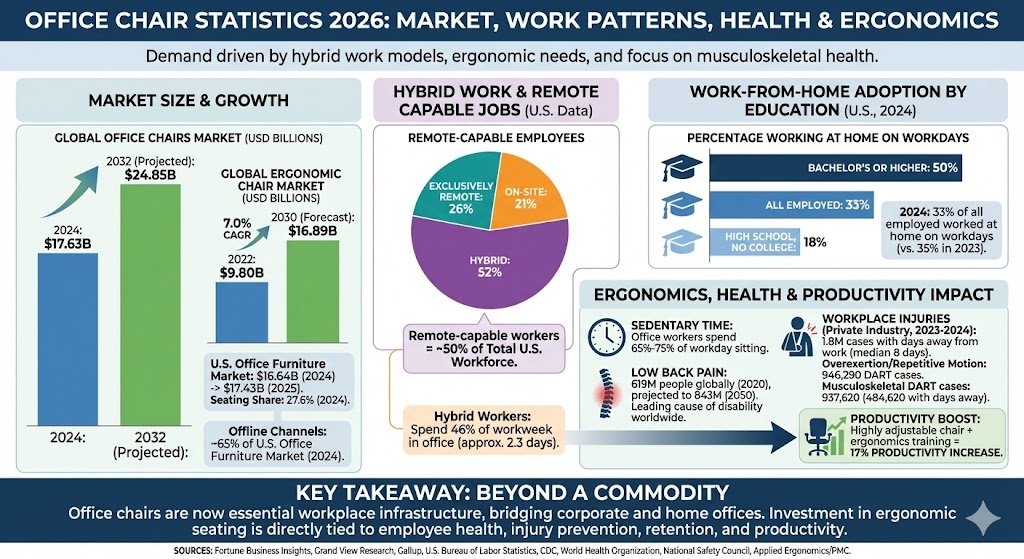
This roundup pulls together the most useful office chair statistics for market size, work patterns, health outcomes, and ergonomics.
Key Office Chair Statistics
- The global office chairs market reached USD 17.63 billion in 2024 and is projected to grow to USD 24.85 billion by 2032.
- The global ergonomic chair market generated USD 9.80 billion in 2022 and is forecast to reach USD 16.89 billion by 2030.
- The U.S. office furniture market was estimated at USD 16.64 billion in 2024 and is expected to reach USD 17.43 billion in 2025.
- Seating accounted for 27.6% of the U.S. office furniture market in 2024.
- Offline channels still represented about 65% of the U.S. office furniture market in 2024.
- Among U.S. employees with remote-capable jobs, 52% were hybrid, 26% were exclusively remote, and 21% were on-site in Gallup’s latest reading.
- Remote-capable workers make up about half of the total U.S. workforce.
- Hybrid workers now spend 46% of their workweek in the office, equal to about 2.3 days.
- In 2024, 33% of employed people worked at home on days they worked, compared with 35% in 2023.
- In 2024, 50% of employed people age 25 and older with a bachelor’s degree or higher did some work at home on days worked, compared with 18% of those with only a high school diploma and no college.
- Office workers spend about 65% to 75% of their workday sitting.
- Low back pain affected 619 million people worldwide in 2020 and is projected to rise to 843 million by 2050.
- Low back pain remains the leading cause of disability worldwide.
- Private industry recorded 1.8 million cases involving days away from work in 2023-2024, with a median of 8 days away.
- The highest-volume event category for DART cases in 2023-2024 was overexertion, repetitive motion, and bodily conditions, at 946,290 cases.
- Private industry experienced 937,620 musculoskeletal disorder DART cases in 2023-2024, including 484,620 cases involving days away from work.
- A field study found that a highly adjustable chair paired with ergonomics training produced a 17% productivity increase.
Office Chair Market Size Statistics
The headline story is steady growth. Office chair demand is no longer driven only by traditional headquarters. It is now supported by hybrid offices, home offices, renovation cycles, and a broader push toward ergonomic seating.
At the global level, the office chairs market stood at USD 17.63 billion in 2024 and is projected to reach USD 24.85 billion by 2032. That points to continued expansion rather than a short-lived post-pandemic spike.
The ergonomic segment is also growing faster than many buyers realize. Grand View Research estimates the global ergonomic chair market at USD 9.80 billion in 2022, with a forecast of USD 16.89 billion by 2030, equal to a 7.0% CAGR.
In the U.S., the broader office furniture market was worth USD 16.64 billion in 2024 and is expected to rise to USD 17.43 billion in 2025. Within that market, seating held the largest product share at 27.6% in 2024.
| Label | Bar | Value | ||
|---|---|---|---|---|
| 2024 |
| USD 17.63B | ||
| 2032 |
| USD 24.85B |
Max = 24.85. Widths: 2024 70.95%, 2032 100.00%.
Hybrid Work and Office Chair Demand
Office chair purchasing is increasingly shaped by hybrid work rather than full-time office attendance. Gallup’s latest data shows that among U.S. employees with remote-capable jobs, 52% are hybrid, 26% are fully remote, and 21% are on-site.
That matters because office chair demand now comes from two directions at once: companies outfitting collaboration-focused offices and individuals upgrading home setups. Gallup also says remote-capable workers make up about half of the total U.S. workforce, which keeps ergonomic seating relevant even when office occupancy is uneven.
Hybrid workers are not disappearing either. Gallup found that they now spend 46% of their workweek in the office, or about 2.3 days. That creates a strong case for higher-quality, adjustable seating in both shared offices and home workspaces.
| Label | Bar | Value | ||
|---|---|---|---|---|
| Hybrid |
| 52% | ||
| Exclusively remote |
| 26% | ||
| On-site |
| 21% |
Max = 52. Widths: Hybrid 100.00%, Exclusively remote 50.00%, On-site 40.38%.
Work-From-Home Statistics That Support Office Chair Sales
Remote work is still large enough to support a meaningful home-office seating market. The Bureau of Labor Statistics reported that 33% of employed people worked at home on days worked in 2024, only slightly below 35% in 2023.
The gap is much wider by education level. In 2024, half of employed people age 25 and older with a bachelor’s degree or higher did some work at home on days worked, compared with just 18% of those with a high school diploma and no college.
That split helps explain why premium task chairs and ergonomic chairs continue to perform well in higher-income and knowledge-work segments.
| Label | Bar | Value | ||
|---|---|---|---|---|
| Bachelor’s or higher |
| 50% | ||
| All employed |
| 33% | ||
| High school, no college |
| 18% |
Max = 50. Widths: Bachelor’s or higher 100.00%, All employed 66.00%, High school, no college 36.00%.
Ergonomics and Health Statistics
Office chair quality matters because sedentary work is still extremely common. CDC-backed research has found that office workers spend about 65% to 75% of their workday sitting.
That matters in the context of low back pain, which the World Health Organization says affected 619 million people globally in 2020 and could reach 843 million by 2050. WHO also identifies low back pain as the leading cause of disability worldwide.
On the workplace injury side, the Bureau of Labor Statistics reported 1.8 million private-industry cases involving days away from work during the 2023-2024 period, with a median of 8 days away from work. The largest event category was overexertion, repetitive motion, and bodily conditions, totaling 946,290 DART cases.
Separately, NSC’s summary of BLS data shows 937,620 musculoskeletal disorder DART cases in private industry during 2023-2024, including 484,620 cases involving days away from work.
Perhaps the clearest business case for better seating comes from intervention research. One field study found that workers given a highly adjustable chair plus ergonomics training achieved a 17% productivity increase, alongside better musculoskeletal and visual health outcomes.
What These Office Chair Statistics Mean
The office chair category is no longer just a commodity furniture segment. It now sits closer to workplace infrastructure. Hybrid work keeps demand spread across corporate and home environments, while the scale of low back pain and musculoskeletal injuries keeps ergonomics central to buying decisions.
For manufacturers and retailers, the most important signal is that office chairs are benefiting from both workplace redesign and long-term health awareness. For employers, the data suggests that seating quality is tied not only to comfort, but also to injury prevention, retention, and productivity.
Sources
- Fortune Business Insights, Office Chairs Market: https://www.fortunebusinessinsights.com/office-chairs-market-103870
- Grand View Research, Ergonomic Chair Market Size, Share & Trends Report, 2030: https://www.grandviewresearch.com/industry-analysis/ergonomic-chair-market-report
- Grand View Research, U.S. Office Furniture Market Size & Share, 2030: https://www.grandviewresearch.com/industry-analysis/us-office-furniture-market
- Gallup, Global Indicator: Hybrid Work: https://www.gallup.com/401384/indicator-hybrid-work.aspx
- Gallup, Hybrid Work in Retreat? Barely.: https://www.gallup.com/workplace/694361/hybrid-work-retreat-barely.aspx
- U.S. Bureau of Labor Statistics, American Time Use Survey 2024 Results: https://www.bls.gov/news.release/pdf/atus.pdf
- CDC Preventing Chronic Disease, Prompts to Disrupt Sitting Time and Increase Physical Activity at Work: https://www.cdc.gov/pcd/issues/2014/13_0318.htm
- World Health Organization, Low Back Pain Fact Sheet: https://www.who.int/news-room/fact-sheets/detail/low-back-pain
- World Health Organization, WHO Releases Guidelines on Chronic Low Back Pain: https://www.who.int/news/item/07-12-2023-who-releases-guidelines-on-chronic-low-back-pain
- U.S. Bureau of Labor Statistics, Employer-Reported Workplace Injuries and Illnesses, 2024: https://www.bls.gov/news.release/pdf/osh.pdf
- National Safety Council, Musculoskeletal Injuries and Illnesses – Data Details: https://injuryfacts.nsc.org/work/safety-topics/musculoskeletal-injuries/data-details/
- Applied Ergonomics / PMC, A Field Intervention Examining the Impact of an Office Ergonomics Training and a Highly Adjustable Chair on Visual Symptoms: https://pmc.ncbi.nlm.nih.gov/articles/PMC4719773/